'hourglass syndrome'
Over the newsletter hiatus, I published a piece with Wired about the pelvic floor, and my struggles with my own pelvic floor over the last several months (PDF at the end of this newsletter, for paid subscribers). I developed debilitating tailbone pain right around the time my book published in May. I’m not sure if anyone could tell, but the entire time during book tour, it was very painful for me to both sit down, sit there, and stand up again. This pain turned out to have many factors. Giving birth, sure. But also stress, sitting too much, and the fact that I have habitually held my breath all my life, in the way that you'd hold your breath while hiding in a closet from a home invader or monster. My pelvic floor physical therapist identified the latter within five minutes of my entering her office, without me even saying anything. (A chilling reminder of how obvious my struggles and traumas sometimes are to everyone but me.)
The piece gets all the way into how complex the pelvis is, a virtual rubber-band forest of connective tissue and muscles, the connecting place for the upper and lower body, the hammock for all our internal and birthing organs. It’s almost surprising that more people don’t have problems earlier and more often on that basis alone, before we get into the way that we locate so much stress and tension in that area.
We trimmed a lot from my A Physical Education draft, and one of the cuts was a brief scene where a friend of mine in high school used to tap my stomach as she passed me in the hallway and say “suck it in.” And she wasn’t joking. It shames me to admit it, but that interaction led me to develop the defensive habit of holding my stomach in, making my waist as small and hard and firm as possible. If at any point I came across my reflection, I developed the mental tic to suck it in. At this point, it is a deeply ingrained habit. Even after all I’ve been through in the last 11 years, I still, still do it without even realizing. Part of my motivation with this book was to catalog these innocuous kinds of interactions that came to govern my behavior to a mortifying degree, to surface the kind of stuff that I felt, or optimistically imagined, just lives in the back of a lot of people’s minds and yet dictates a significant part of their, our, day.
So now I’m more than two decades in to sucking in my stomach virtually all the time. Like most things I’ve ever done, I thought I was just performing my obligation to be as hot as possible at all times. It was an annoying burden, sure; a habit I would not have readily admitted, of course. But I did not think it could be a medical problem.
The length of my pelvic floor piece was already testing the patience of my editor, but it could easily have been twice as long. It was only after turning it in that I learned about “hourglass syndrome”—yes, the real name for the health implications of sucking in your stomach too much for too long. And the implications are many: breathing problems, muscular imbalances, neck and back pain, and, dun dun dun, pelvic floor problems. Pelvic floor problems so acute, perhaps, that you can’t even sit down without pain.
I’ve had my breath-holding habit much, much longer than my stomach-sucking habit, since before I can remember. I would claim that it’s a difficult habit to break (and my sucking-in likely made it worse). Still, in that time, I learned to always hold my stomach sucked in, a very similar and arguably more difficult habit. My pelvic floor PT told me, in essence, to finally try and stop holding my breath, to learn to relax my pelvic floor at rest. I imagine she’d approve of learning to stop sucking my stomach in, too.
So, since learning about hourglass syndrome, I’m trying to bravely occupy the real estate a few inches in front of me, and avoid every pant that discourages this process. A thing that I didn’t even realize I had been dying to embrace was what lives in my mind as “mom clothes,” which means paving the trail carved by my Merrell jungle mocs and mostly wearing these L.L. Bean pants. I believe I imagined that when I started embracing generous clothes, that it was a phase that would end. I did not realize I might like it so much that I might never stop, that I might decide I gave the world 20-plus long years to police every aesthetic drop out of me, and that is plenty.
Pelvic floors are tricky, in that their seemingly acute problems are actually longstanding chronic issues coming to head, and it feels unfair that the seemingly acute problems do not have an equally acute solution, unfair that I didn’t know I was helping the storm gather over the course of 20-plus years when I was just trying to do the right thing. At the same time—oh nooo, haha, I am medically obligated to wear soft pants.
Eat
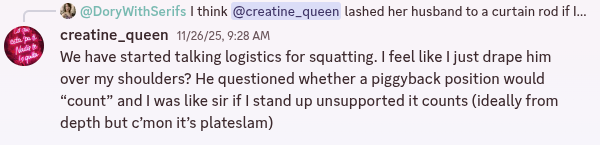
~Liftcord Pick of the Week: PLATESLAM, our annual holiday celebration of gains and creative PRs, approaches! Headquarters will be in the Liftcord for paid subscribers, where many will post their PRs from December 12-14 and cheer each other on accordingly, but technically you can celebrate and/or post wherever you find meaning. See my 2023 PR from above, my 2024 PR was birthing a child, and here's a taste of one subscriber's 2025 PR planning:
~
Pattie Gonia, a jacked environmentalist, hero for our times, and one of the few great remaining Instagram follows, challenged Pete Hegseth to a pull-up contest. Far be it from me to form-police, but Hegseth’s pull-ups are more like barre pulses. I hope that someday he and Marjorie Taylor Greene can find their way to a pull-up mid-off.
On gettin’ naked in the Vermont woods.
On "inter-organ cross-talk" and the endocrine functionality contribution of skeletal muscle. This paper from November builds on the general theory that bodily functions and health are not as concretely located in specific parts and organs as we might think—i.e., if muscle use/maintenance affects our hormone levels (which, we are pretty sure it does), how does that affect our understanding of what the endocrine system even is? A lot, potentially.
 Casey Johnston

Drink
Internet recipes are becoming useless thanks to AI slop. Googling a recipe seems like a fast way to waste a bunch of food lately. I have been going directly to the source of blogs I can remember (Smitten Kitchen, e.g.), or increasingly, straight to cookbooks. Joy of Cooking forever.
Is it ethical to recruit actors with anorexia? This piece is missing the entire component of whether the roles in question glorify or critique eating disorders (standard New York Times L). That said, if it is unethical to recruit actors with anorexia, I have bad news about gestures so broadly at the last 60 years of Hollywood that both arms separate from my body, boomeranging away until they curve back and knock me unconscious
Rest
Over the break, I published a very detailed post on how to read more. Reading is sometimes one of the only activities that can calm my brain, so if I don’t protect it, many things fall apart.
On repairing attention spans: “exhausting a place,” and consider doing nothing.
The stability and trustworthiness of non-screen things.
This video made its way to multiple group chats and channels, which is how you know it will hit: "Why Movies Just Don’t Feel 'Real' Anymore," on the need for haptic visuals. This touches on embodiment and how our realities are created through the sensory experience of our bodies, which I’ve been very interested in lately.
Important cultural reading on the “Crazification Factor,” a.k.a. the Keyes Constant, a.k.a. the upsettingly large swath of people who will continue to support a candidate no matter what.
On finding fatherhood in motherhood.

That’s all for this week! I love you for reading, thank you, let’s go—
Wired Pelvic Floor PDF for paid subscribers may be found here (note that it was posted in the Liftcord first!):