
the plot to strangle the American of life, liberty, and happiness, part two
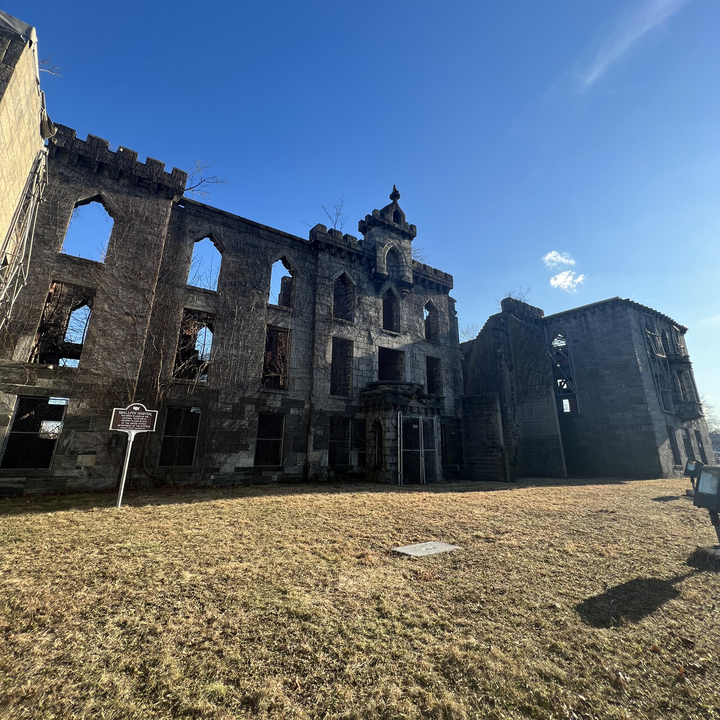
On the much-derided Roosevelt Island of New York City, there sits the ghost of a former smallpox hospital. It is, and was, called Smallpox Hospital. It’s an empty but surprisingly mighty Gothic building that is now mostly a facade, empty and viewable only from the outside. This building is probably the most well-known thing about Roosevelt Island, apart from the aerial tram. The last and only time I set foot there was back in January of 2022, and it was (unintentionally) one of the last places I visited before moving away from New York, when my future husband and I decided to go wandering there (it was easy to start to run out of places to wander even in New York, if you were following COVID rules).
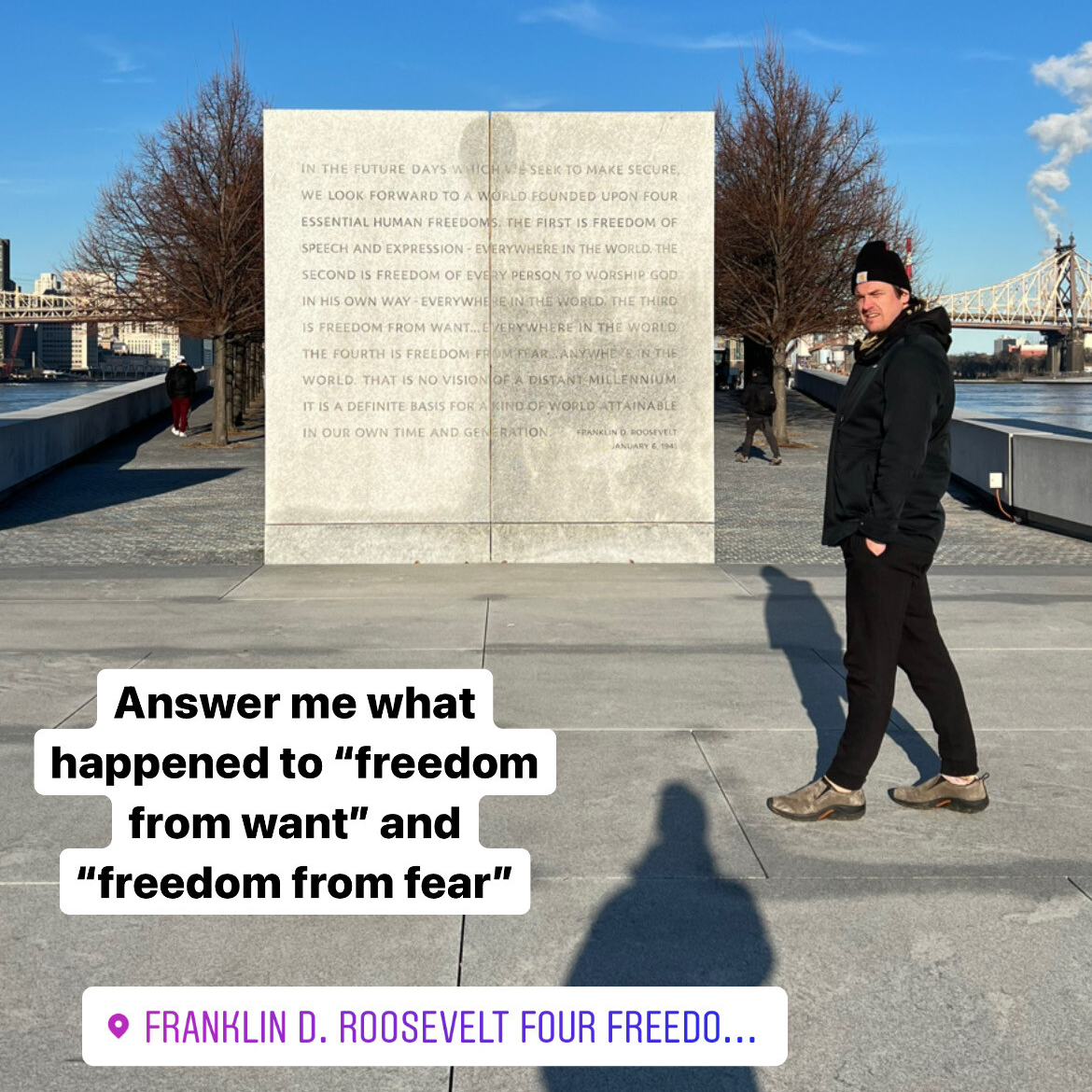
But as I found out literally there and then, after we were done with the hollow Smallpox Hospital, there is another feature of Roosevelt Island that I’ve never heard anyone talk about in terms of either content or existence, and was totally surprised to find at the very southern tip of the island on that cold January day. It’s the Franklin D. Roosevelt Four Freedoms Park. (I had lived all my life proximal to, and then in, New York, and you will simply never hear anyone say, “oh, you gotta go visit the Franklin D. Roosevelt Four Freedoms Park,” or “the Franklin D. Roosevelt Four Freedoms Park is fine, but skippable,” or even “avoid at all costs the Franklin D. Roosevelt Four Freedoms Park.”) I’d never heard of the Four Freedoms themselves, either, even though I have vague memories of taking A.P. U.S. History once upon a time. Yet there they were, those Four Freedoms, engraved in a giant stark block of stone, as if they are not only known, but never to be forgotten.
The quote goes like this:
In the future days we seek to make secure, we look forward to a world founded upon four essential human freedoms. The first is freedom of speech and expression—everywhere in the world. The second is freedom of every person to worship god in his own way—everywhere in the world. The third is freedom from want… everywhere in the world. The fourth is freedom from fear… anywhere in the world. That is no vision of a distant millennium. It is a definite basis for a kind of world attainable in our own time and generation.
The historical context here is that this quote is drawn from FDR’s State of the Union speech delivered on January 6, 1941, after everyone had been watching the surge of Nazi Germany for a few years, but almost a year before the Pearl Harbor bombing. FDR was apparently trying to drum up support for the U.S. to involve itself in helping secure the world globally according to our politics, which played not a small role in us becoming the Team America: World Police as we know ourselves today. But ignoring that unfortunate outcome for a moment, reading the Four Freedoms blissfully absent of content, it seemed to me like a striking summary of how to define a decent human existence.[^1] I’ve thought often about the Four Freedoms since. I’ve wished they did not sit, lonely in a park on a little-visited island, facing not in toward the land but out to the river. You couldn't even see them from a distance unless you were passing by on a boat.
Freedom of speech and worship are the famous American freedoms. We know about those, and we hardly ever stop talking about them. They were easy to imagine in the negative space of escaping monarchy. Freedom from want and fear, by contrast, are not inalienable rights guaranteed by the constitution. But those two additional proposed freedoms feel like they modernize the goals of a democracy, define it away from broad open-ended self-determination—which, if no one has noticed, is not working out very well—and give some structure to the positive space we could or should be swimming toward: that it is possible, practical, and even necessary to a functioning democratic society to meet everyone’s basic health and security needs, and to structure our world to sufficiently protect each other, so that no one has reason to feel threatened by anyone else.
Now, it feels like we almost live in a funhouse-mirror version of the worst future timeline that FDR could only imagine in 1941. Sometime between 1941 and now, the idea of “freedom from want” became not only no longer a priority, but antithetical to how things work around here. “Want” drives the vicious cycle of our existence. We are set up to think we are supposed to solve most of our problems by want—you have to want it even just to eat decent food; you have to want it to have physical health; you have to want it to have a good education and establish yourself beyond a sixth-grade reading level; you have to want it to have a stable career, and want it for that career to be stable enough to support a family. You have to want it to have shelter and basic dignity. We’ve baked want so deeply into the American experience that we now fully believe that wanting is supposed to be part of the “””fun,””” that literally there is no “deserve” without “want.”
By freedom from fear, FDR was obviously dropping hints about, specifically, Nazis. But it’s another good one to consider more broadly: do we even have freedom if so many aspects of our lives are daily nightmares? School shootings? A 1 in 100 lifetime chance of dying in a car crash? Rapidly increasing odds of dying in a plane crash thanks to a limping FAA? Looming Iran War draft? How long do we need to make this list?
I don’t say all this to monger fear; I live bravely through each day, myself. But it’s plain how investment in fear drives so many decisions, both at the systemic and individual level: police presence, restriction on social resources, the individual purchase of literal weapon arsenals and tanks we drive on public roads, the inability to leave our houses without a car.
On a recent podcast episode of Design Matters with historian Timothy Snyder as a guest, Snyder described this as a politics of “sadopopulism,” or essentially: [the] government doesn’t solve your problems, it blames your problems on other people,” with the only guarantee being that more suffering will be inflicted on the blamed people: As Snyder told Slate in 2018, “at [a] vulnerable moment, there are two things you can say: The good guys will say, ‘Look, this shows that we all need a little help sometimes. Let’s build up something like a social democracy.’ The bad guys are going to say, ‘Look, this shows how the Mexicans are taking your jobs, and the Muslims are killing you, and the black people hate you, etc.
“One of the truths that is rarely stated in American public discourse is that the welfare state exists to sustain a more or less politically reasonable middle class. You break the welfare state in this country in order to make the white people crazy. You don’t do it to punish the black people. That’s what you say you’re doing — and maybe you take a pleasure in doing that. But ultimately what you’re doing when you break the welfare state in this country is that you’re hurting white people. Trump and his allies can then direct that vulnerability for political ends.”
So as things are, you may be sent into lifelong crippling debt by one health problem coming to bear; you may lose your house to a natural disaster and corresponding lack of insurance; you or your children may not survive a random shooting, because no amount of additional weapons or law enforcement can prevent them, and those are the only resources we are willing to devote to that particular cause. Not only can these problems not be solved individually, or by persecuting random groups of people; they can only be solved by collective actions and decisions and policies that establishes a floor—a floor that constitutes freedom from want, and freedom from fear.
I like the “freedom from fear and want” framing because, when the self-determination framing is accepted, the question in the face of all these nightmares becomes, what are we supposed to do? Pretend this all isn’t happening? Give up and suffer? Well, no—we have to remember it is possible, feasible, even easy to construct things in a way that we don’t all feel on the run, constantly, trying to escape the various grips of literal and existential threats to our livelihood, while we are also getting cut off at the knees. The idea that it’s somehow difficult or impossible to establish a basic amount of physical and existential security is just plain fiction, and the only people who can protect us from that fiction are ourselves and each other. The threats just shouldn’t be there. Freedom to do your best to run away isn’t freedom at all; freedom from having to run away, is.
 Casey Johnston
 Casey Johnston
 Casey Johnston
Drag Queen Pattie Gonia calls out Secretary of Defense Pete Hegseth: “Here's me benching 130lbs with perfect form, with my dick tucked, you could never you little bitch”
by u/LunaLore_ in Fauxmoi
Eat
~Liftcord Pick of the Week: 90-year-old Ann Crile Esselstyn set a new Guinness World Record for “oldest woman to hold a dead hang,” for 2 minutes and 52 seconds.~
Pattie Gonia calls out Pete Hegseth for lifting obviously fake weights and then dumbbell-benches 130lbs, feet-up.
“Joined by her Forbidden Fruits co-stars Lola Tung, Victoria Pedretti and Alexandra Shipp, Reinhart was asked to name the “acting note that she took personally.” She did not hesitate to answer: ‘When I had a male director come up to me and silently lean over and go, ‘Just suck in your stomach a little bit.'’” This is how hourglass syndrome starts!
Drink
Thrilled to see the r/Costco subreddit catch on to the collagen protein-inflation scam, regarding “Joyburst Protein Soda.” (More on collagen here.)
More and more youth are reconnecting to the real world by replacing their smartphones with dumbphones. Here are their kits. I especially relate to several of them saying how removing their smartphones from their lives has led them to talking to more people, and it's been an overwhelmingly positive experience. (My little dumbphone project here.)
Explain It Peter
by u/eldritchfloppa in explainitpeter
Rest
I dug through Susan Orleans’ New Yorker archives this week, and found this piece on Gray’s Papaya and this piece on Thomas Kinkade. (Previously on Orlean’s immaculate-vibes surfer girl piece that became the basis for Blue Crush.)
Enjoyed the press about Snail Mail from last week. My millennials and xennials and Xers, please listen to 15 or so seconds of the opening riff of her song “Tractor Beam” here and tell me what ‘90s song it reminds you of.
An interview with Apple’s unsung third founder, Ronald G. Wayne. It all started when Steve Jobs said, “hey Wayne, let’s start a slot machine company,” basically.
That’s all for this week! I love you for reading, thank you, let’s go—
[F1] Here I’ll ask you to ignore that I never really thought about the fact that we call it Roosevelt Island, thus it makes sense for there to be some kind of “Roosevelt Park” there. Also I hope this speech doesn’t have some kind of weird reputation among or implication known to political experts. If so, I don’t know anything about that; I just liked the ideas in principle. Likewise, someone’s going to probably say “this is just about the war and is not supposed to have any wider implication or meaning”; well, then he should not have made this combination of words so germane to our current moment.



Member discussion